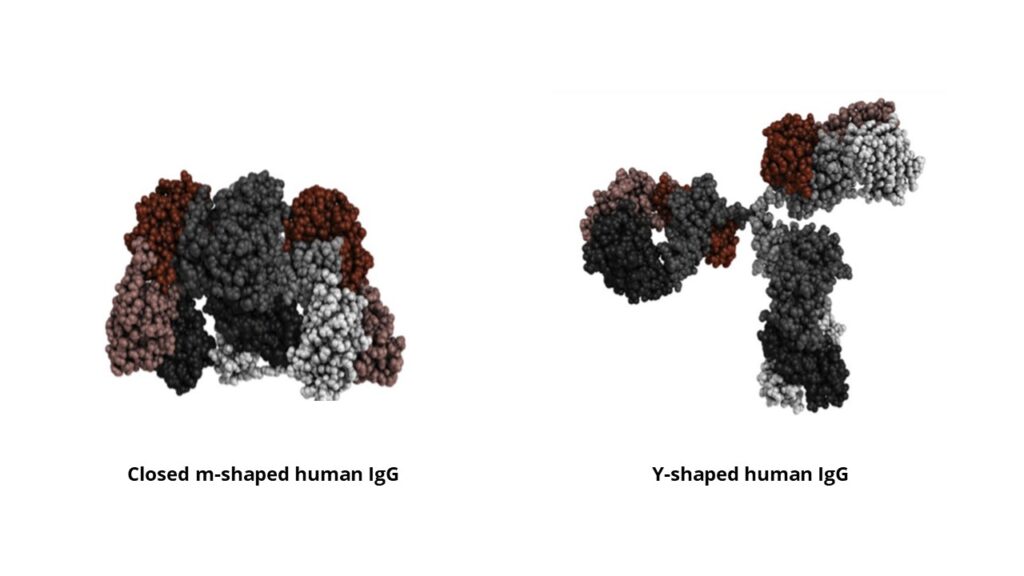
Antibodies are large multimeric proteins. In their simplest form they are composed of two identical light chains and two identical heavy chains, covalently linked together by disulfide bonds.
Each peptide chain comprises domains, which are folded into a compact structure, consisting of two β-pleated sheets each containing antiparallel β-strands connected by loops. The stabilization of each domain is obtained by a single disulfide bond and several noncovalent interactions.
The N-terminal domain of each peptide chain is highly variable in its amino acid composition, while the remaining C-terminal domains have constant amino acid sequences. The number of constant domains in the heavy chain is defined by the antibody isotype, whereas the light chain only contains a single constant domain.
A hinge region, primarily comprised of Pro and Cys, is found within the heavy chains, which contributes with flexibility to the antibody. Due to the increased flexibility in this region, antibodies may fold into the characteristic Y-shaped structure but also a rather unknown m-shaped structure.